
What to Eat When IBS Makes Meal Planning Feel Impossible
IBS can make meal planning feel overwhelming. Learn how simple meal templates, gentler swaps, and food-symptom tracking may help you plan with less guessing.

It’s 6 PM. You’re hungry, tired, and standing in front of the fridge.
You do not want another random snack. You want dinner. But every option feels like a question mark.
Will this make me bloated?
Will I regret this later?
Was this food fine last time, or was that just a good day?
Should I cook something simple, order in, or eat the same few foods again?
When you are dealing with IBS, meal planning can stop feeling like planning. It can feel like risk math.
The hard part is not always knowing what “healthy” means. Sometimes the hard part is figuring out what your body can handle today.
And when you are overwhelmed, the answer is usually not to keep cutting out more foods at random. A better starting point is to simplify the decision, notice what tends to work for you, and build meals that are easier to repeat, adjust, and learn from.
Why IBS meal planning can feel so overwhelming
IBS food decisions can feel confusing because there is not one universal food list that works for everyone.
The National Institute of Diabetes and Digestive and Kidney Diseases notes in its IBS diet and nutrition guidance that different dietary changes may help different people with IBS. A doctor may suggest changes like eating more fiber, avoiding gluten, or trying a low-FODMAP diet, depending on the person and their symptoms. The NIDDK also notes that a doctor may recommend talking with a dietitian.
That variability is part of what makes meal planning so exhausting.
A meal can feel okay one day and different another day. A food that seems “safe” can become confusing when symptoms show up later. A generic trigger list might tell you what commonly bothers some people, but it cannot tell you exactly what is happening in your body, on your schedule, with your stress, sleep, portions, and routines.
So people often respond by shrinking their diet.
They eat the same few meals. They avoid more ingredients. They stop experimenting. They start planning around fear, not nourishment.
That is understandable. But it can also make food feel smaller and more stressful over time.
Start with meal templates, not a perfect IBS food list
When IBS makes meal planning feel impossible, try shifting the question.
Instead of asking, “What foods are safe for IBS?” ask:
“What simple meal structure can I repeat, adjust, and learn from?”
A meal template is not a strict diet plan. It is a starting structure that lowers the number of decisions you have to make.
For example:
-
A protein
-
A starch or grain
-
A cooked vegetable or another vegetable option you tend to tolerate better
-
A small amount of fat, sauce, or seasoning
-
Optional add-ons that already feel familiar to you
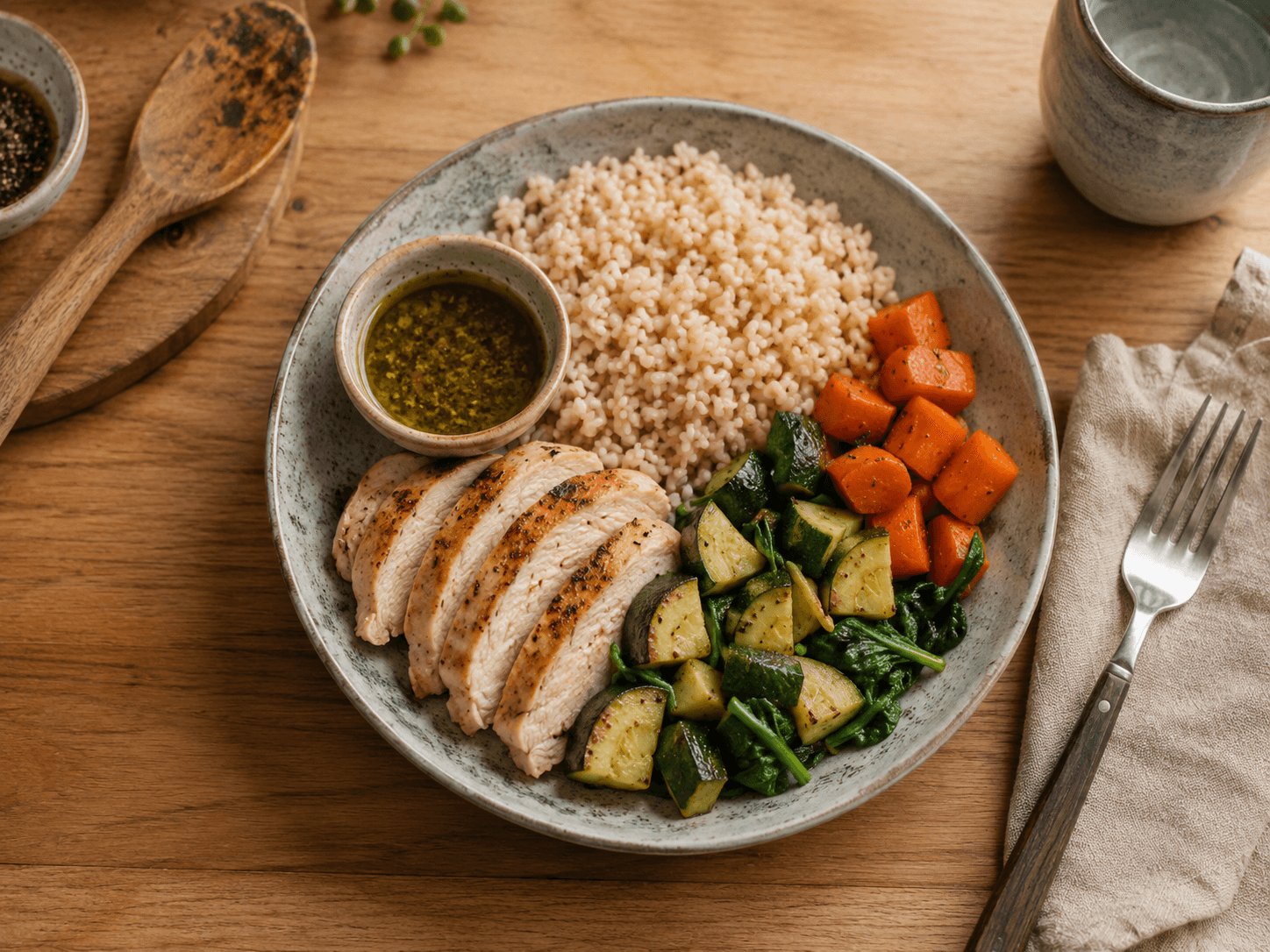
That could look like chicken, rice, cooked carrots, and a simple sauce. Or eggs, potatoes, and spinach. Or tofu, quinoa, and roasted zucchini. These are examples, not universal IBS-safe meals. The exact foods depend on your preferences, culture, symptoms, medical needs, and what you tend to tolerate.
The goal is not to create the perfect IBS meal. The goal is to make dinner feel possible again.
Once you have a few repeatable templates, you can adjust one thing at a time instead of reinventing every meal from scratch.
Try gentler swaps before cutting out whole meals
When a meal seems to bother you, it is tempting to blame the whole thing.
But sometimes a smaller change may be more useful than removing an entire food group.
You may notice:
-
Raw vegetables feel harder for you than cooked vegetables.
-
A large portion of beans feels different from a small portion.
-
A rich sauce feels different from a simpler one.
-
Eating quickly feels different from eating slowly.
-
A meal late at night feels different from the same meal earlier in the day.
None of this proves a trigger. It just gives you something to notice.
Monash University describes the first step of the low-FODMAP diet in its starting the low-FODMAP diet guidance as swapping high-FODMAP foods for low-FODMAP alternatives, rather than treating the process as random restriction. Monash also frames the full FODMAP process as a 3-step approach: substitution, reintroduction, and personalization.
That idea matters beyond low-FODMAP: meal planning is often easier when you make small, trackable swaps instead of starting over completely.
What about low-FODMAP meal planning?
Low-FODMAP can be useful for some people with IBS, but it should not be treated as a casual forever diet or a universal rulebook.
Monash University’s low-FODMAP diet guidance describes the FODMAP diet as a 3-step process designed to help people learn which foods and FODMAPs they tolerate, with the goal of a less restrictive and more nutritionally balanced long-term diet.
The NIDDK’s IBS diet guidance similarly notes that if symptoms improve during a low-FODMAP trial, a doctor may recommend slowly adding FODMAP-containing foods back into the diet.
So if you are exploring low-FODMAP, it may be worth doing with guidance from a qualified clinician or registered dietitian, especially during elimination and reintroduction.
The goal should not be to live in fear of more foods. The goal is to learn what may work better for you.
Build a “good enough” IBS meal-planning system
You do not need a 30-day meal plan to start.
You may need a small set of meals that make the week feel less chaotic.
2 repeatable breakfasts
These could be simple options you already know how to make. Think of meals that are easy to adjust, like oatmeal, eggs with toast, a smoothie, or a yogurt-style bowl, depending on what fits your body and needs.
2 simple lunches
Lunch can be a rice bowl, quinoa bowl, soup, leftovers, or a simple plate meal. The key is to avoid making every lunch a new puzzle.
2 low-effort dinners
Dinner can follow the same basic structure: protein, starch, cooked vegetable, simple flavor. The ingredients can change, but the decision framework stays the same.
3 backup options
These are for days when symptoms are active or your brain is tired. They do not need to be exciting. They just need to be realistic options that have tended to work better for you.
This kind of system gives you a base. From there, you can test small changes and notice what happens.
Track what works without turning meals into a spreadsheet
When you are relying on memory alone, it is easy to overreact to one bad day or forget what actually happened.
You do not need perfect tracking. You need enough context to review later.
Helpful notes might include:
-
What did you eat?
-
How much did you eat?
-
How was it prepared?
-
When did symptoms show up, if they did?
-
How intense were they?
-
What else was happening that day?
-
How did you sleep?
-
Were you stressed?
-
How hydrated were you?
-
Did you eat quickly?
-
Did the same meal feel different another time?
Mayo Clinic suggests in its IBS diagnosis and treatment guidance that people preparing for an IBS appointment may write down symptoms, possible triggers, key medical information, recent changes, stressors, and questions for a healthcare professional.
That same idea can help with meal planning. You are not trying to prove that one food caused one symptom. You are trying to collect clues over time.

When to get extra support
If meal planning has become very restrictive, stressful, or fear-based, it may be worth talking with a qualified clinician or registered dietitian.
The American Gastroenterological Association includes dietary counseling, such as increased soluble fiber or a low-FODMAP diet, or referral to a dietitian in its guideline-based best practices for IBS. The AGA also recognizes the brain-gut axis and therapies such as cognitive behavioral therapy or gut-directed hypnotherapy, which is a reminder that IBS support is not always only about food.
You should also seek medical guidance if symptoms are severe, persistent, worsening, unusual, or concerning. Mayo Clinic’s IBS guidance lists symptoms that may suggest another condition, including weight loss, rectal bleeding, fever, repeated vomiting, nighttime belly pain or diarrhea, and iron-deficiency anemia.
Food tracking can be useful. It should not replace medical care when something feels wrong.
How Flourish can help you plan with less guessing
Meal planning gets harder when you are relying on memory, screenshots, scattered notes, and generic food lists.
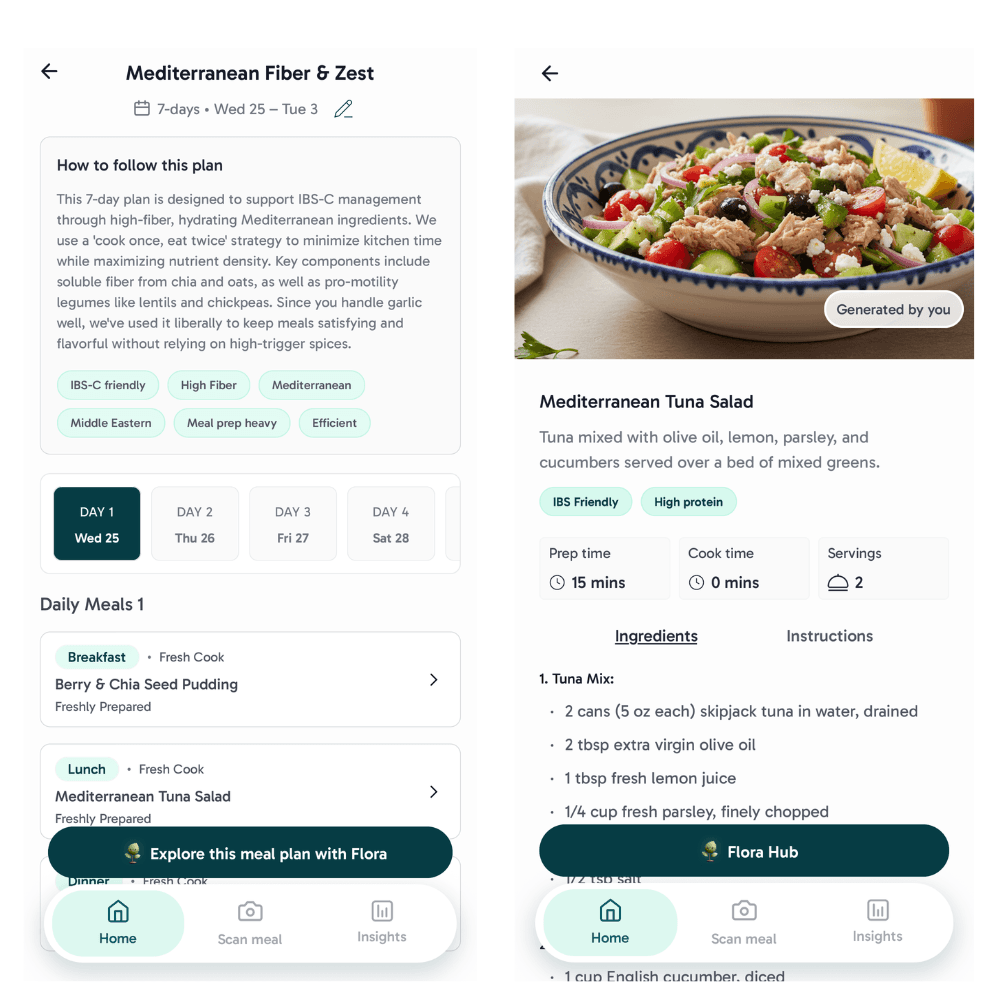
Flourish helps you log meals, symptoms, and health context in one place, then look for possible patterns over time. It is not a diagnosis tool, and it does not replace medical care. But it can help you move from “I have no idea what to eat” toward practical next steps.
That might mean noticing which meals seem better tolerated, reviewing what was happening around symptoms, asking Flora to talk through a confusing food reaction, or turning meal ideas into recipes, meal plans, and grocery lists.
The goal is not to give everyone the same IBS food list.
The goal is to help you learn from your own body, your own meals, and your own routines.
If you are tired of guessing, Flourish can help you track meals, symptoms, and health context in one place so you can start noticing patterns and planning with more clarity.
You do not need the perfect meal plan
When IBS makes food feel complicated, start smaller.
Pick a few repeatable meals.
Make gentler swaps.
Track what happens.
Look for repeated patterns, not one-off reactions.
Ask for support when symptoms are concerning or when restriction starts taking over your life.
You do not have to solve everything this week.
You just need a way to make the next meal feel a little less impossible.
Educational note: This article is for educational purposes only and is not medical advice. Flourish is not a diagnosis or treatment tool. If your symptoms are severe, persistent, worsening, unusual, or concerning, consider talking with a qualified clinician.